Affogato: Hot Espresso Meets Cold Gelato in a Glass
An affogato is Italy's two-ingredient treat: a shot of hot espresso poured over cold gelato. Here's the ratio, why the contrast works, and how to get it right.
This post may contain affiliate links — see the full disclosure.
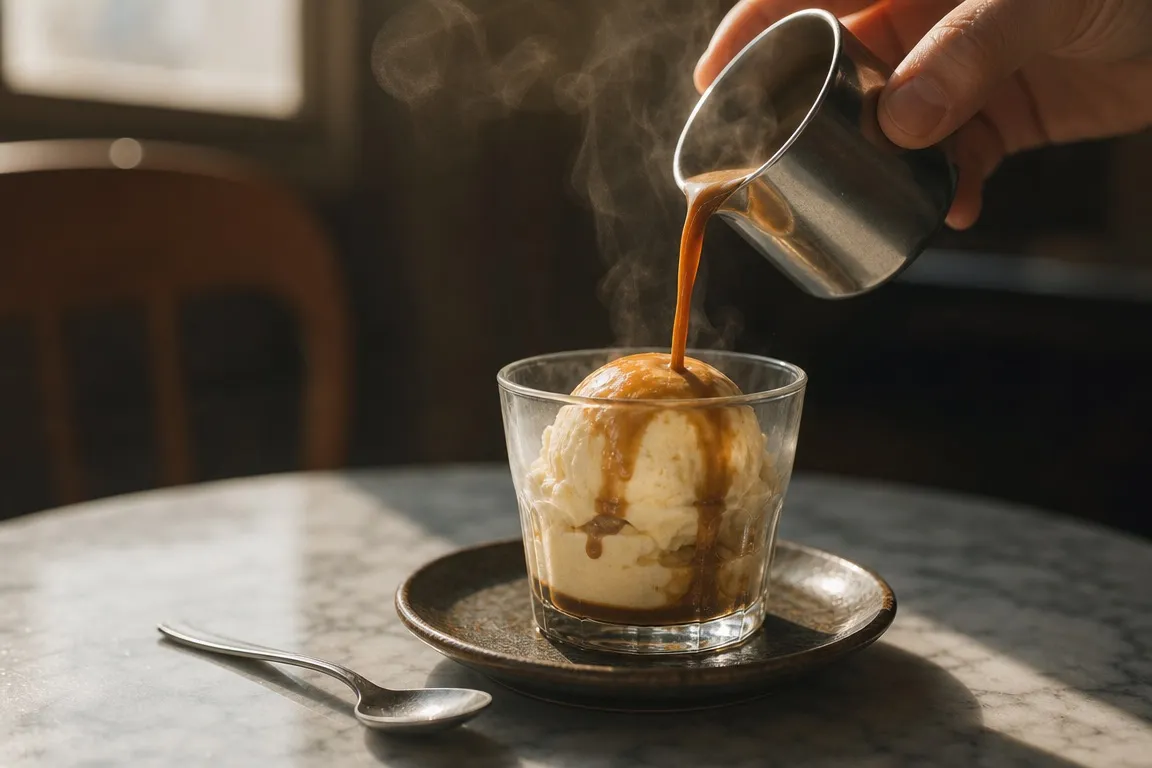
The word means “drowned.” An affogato is, in the most literal Italian sense, a scoop of gelato drowned in coffee: you pour a hot shot of espresso straight over cold gelato and eat it before the two make peace. Two ingredients, no technique to speak of, and one of the best things you can do with an espresso machine that has nothing to do with pulling the perfect shot for its own sake.
It sits in a funny spot. In Italy it’s usually treated as a dessert, something you order at the end of a meal and eat with a spoon. Outside Italy it tends to show up on the coffee side of the menu, half drink and half pudding. Both are right. You eat the firm gelato with a spoon and drink the sweet, cooled coffee that pools at the bottom.
What actually goes in an affogato
The classic version is deliberately plain: one scoop of gelato, one shot of espresso poured over the top. That’s it.
The traditional gelato is fior di latte (a plain sweet-milk flavor) or vanilla. The point of keeping it plain is that the espresso is supposed to be the loud ingredient. A mild, milky-sweet base gives the coffee room to be bitter and aromatic against it. Chocolate, hazelnut, and pistachio all work and taste great, but they start competing with the coffee rather than framing it.
On proportions, don’t overthink it. Sources land in slightly different places, so treat this as a starting direction rather than a law:
| Typical starting point | |
|---|---|
| Gelato | 1 generous scoop (roughly 3 to 4 oz / 85 to 115 g) |
| Espresso | 1 fresh single shot (~30 ml), poured hot |
| Vessel | A small glass or a wide cup, cold if you can |
If you like a more bitter, coffee-forward result, or your gelato is on the sweet side, pull a double and pour that instead. The ratio is a preference dial, not a rule. What matters far more than the exact grams is that the gelato is cold and firm and the espresso is hot and fresh when they meet.
How to make one
- Chill the glass if you have a minute. A cold vessel buys you a little more time before everything melts.
- Scoop the gelato in first, straight from the freezer so it’s properly firm.
- Pull your espresso, and pour it over the gelato right away, while it’s still hot.
- Serve it that second, with a spoon. Don’t let it sit.
That’s the method. The only timing rule that matters is that the espresso goes over the gelato at the last possible moment and reaches the table immediately.
Why the hot-and-cold contrast is the whole point
Pour hot espresso over frozen gelato and you get three things happening in the same glass at once. The espresso melts the outer layer of the gelato into a silky, coffee-laced cream. The core of the scoop stays cold and firm. And where the two meet, you get a warm, half-melted band that’s the best bite in the glass.
That contrast is the entire experience, and it has a short shelf life. Within a couple of minutes the gelato has mostly surrendered and you’re left with a glass of sweet, lukewarm coffee. Still pleasant, but the magic is gone. This is why every source says the same thing: serve it immediately, and eat it while it’s still fighting back.
There’s a second reason the affogato is worth caring about, and it’s a useful lesson for anyone working on their espresso. There’s no milk here to hide behind. A latte or a cappuccino will forgive a slightly sour or harsh shot because the milk rounds everything off. An affogato won’t. The espresso lands almost neat on a plain sweet base, so whatever the shot is doing, you taste it. If your shot reads sour or bitter here, that’s real feedback about your extraction, not the gelato’s fault. In that sense it’s a surprisingly honest way to check your work at the machine.
Gelato or ice cream: does it matter?
It does, a little, and the reason is texture rather than snobbery.
Gelato is churned slower and served a touch warmer than ice cream, and it carries less air and usually less fat (roughly 4 to 9 percent, against 10 percent or more for ice cream). Less air means it’s denser. That density is why gelato melts into a richer, more velvety sauce and holds its shape against the hot espresso for a bit longer.
Ice cream works fine, to be clear. It’s just airier and often higher in fat, so it tends to melt faster and thinner, and it can dilute the drink a little sooner. If gelato is what your shop has, use it. If it’s a tub of good vanilla ice cream in your freezer, use that. The affogato is not precious about it.
Variations worth trying (and the restraint that keeps it good)
Once you’ve made the plain version a few times, there’s room to play, as long as you remember that its appeal rests on simplicity.
- A splash of liqueur. Amaretto is the classic add, with hazelnut liqueur or a coffee liqueur close behind. A small pour, stirred in or over the top, turns it into an easy grown-up dessert. These aren’t part of the traditional recipe, so treat them as an occasional flourish.
- A different gelato. Pistachio, hazelnut, and stracciatella all pair well with coffee. You lose a little of the espresso-forward clarity, but they’re delicious.
- Non-dairy. A good oat or coconut gelato with a solid shot over it makes a lovely vegan version. The mechanics are the same.
- Something with crunch. A biscotto on the side, or a few toasted nuts on top, adds texture without stealing the show.
The one thing to avoid is piling on. Syrups, whipped cream, and three toppings bury the espresso, and the espresso is the reason you’re doing this instead of just eating ice cream.
Common ways it goes wrong
Most disappointing affogatos fail for one of a few reasons, and all of them are easy to head off:
- The espresso was weak or cool. A thin, tepid shot can’t melt the gelato properly and gets swamped by the sweetness. Pull it fresh and pour it hot. If your shots run consistently weak, grind size is usually the first thing to check.
- The gelato was too soft. It melts on contact and the contrast never happens.
- It sat too long before serving. The window is short. Assemble and serve.
- Too much going on. Extra flavors and toppings drown out the coffee that’s supposed to be the point.
For something with almost no documented history (the origins are genuinely murky, and the term only turns up in English dictionaries around the late 1980s and 1990s), the affogato has aged well. It asks for nothing you don’t already have if you own an espresso setup, and it rewards a good shot without demanding one. Next time you’ve got gelato in the freezer and a machine that’s already warm, drown a scoop and see.
Sources: Wikipedia: Affogato; Merriam-Webster: affogato; Healthline: Gelato vs. Ice Cream; Tasting Table: the hazy origins of affogato.