Coffee Grind Size, From Espresso to French Press
A plain-language map of grind size across brewing methods, why it matters more than almost any other variable, and how to dial it by taste.
This post may contain affiliate links — see the full disclosure.
If you only fix one thing about your coffee this year, make it the grind. Not the beans, not the kettle, not the machine. The grind. Coffee grind size controls more of what ends up in your cup than almost anything else, and most people who think their beans are mediocre just have it in the wrong place.
The idea underneath it is simple. Flavor comes out of the grounds when water touches them, and finer grounds give the water more surface to pull from. So fine grounds extract fast, coarse grounds extract slow. The whole job of grind size is to match how long your method keeps water and coffee together.
The logic in one breath
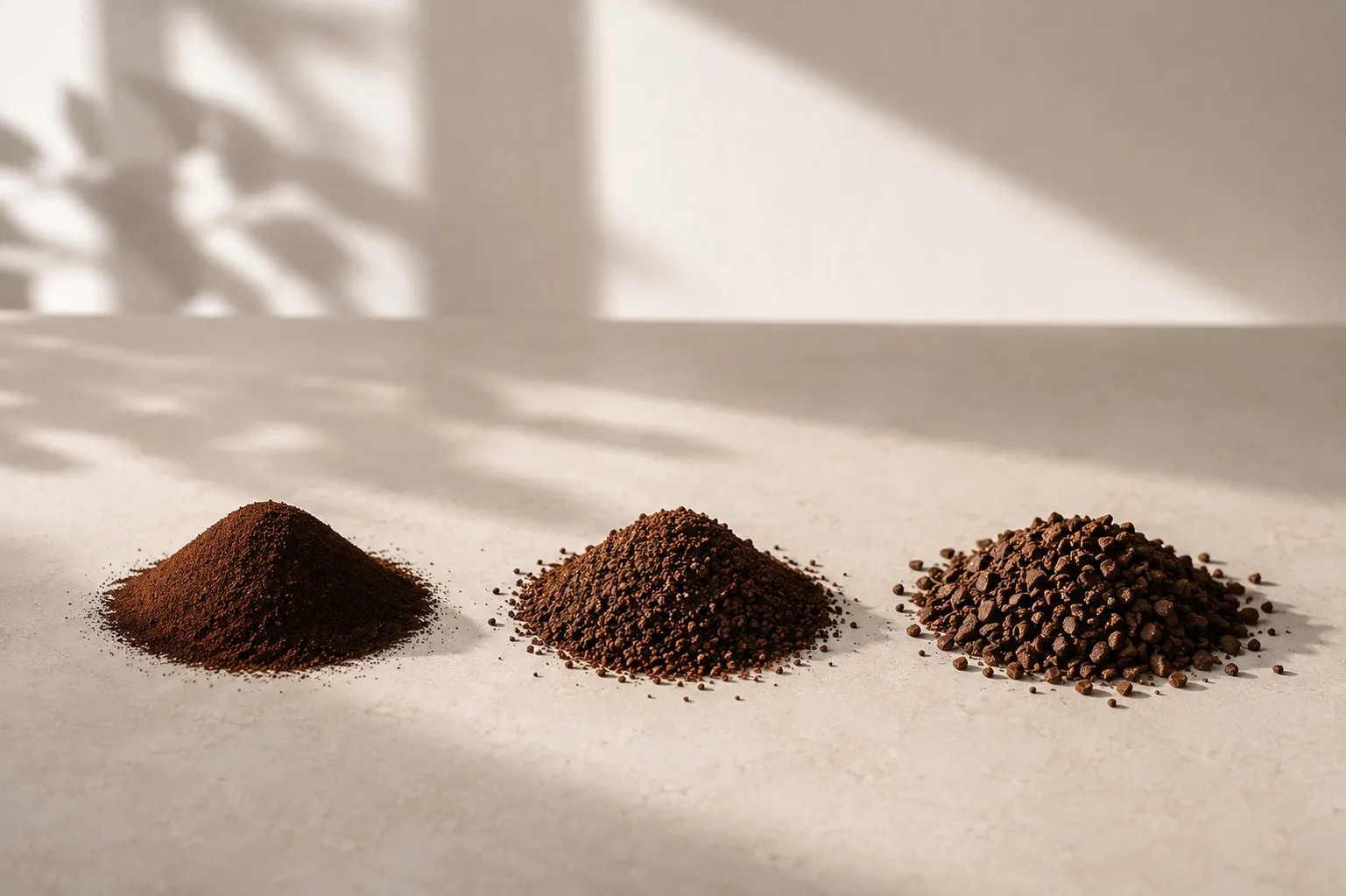
Espresso pushes water through the coffee in about half a minute, so it needs a fine grind to extract enough in that short time. A French press steeps for four minutes, so it needs a coarse grind, or it over-extracts into bitterness and leaves you chewing sludge. Everything else lives between those poles. Short contact time wants fine; long contact time wants coarse. Once that clicks, the chart below is something you can reason out rather than memorize.
A rough grind size map by method
Ballpark ranges in microns (just a unit for particle size). You don’t measure anything; these show the spread, not targets to hit exactly.
| Method | Grind | Microns (approx.) | Feels like |
|---|---|---|---|
| Espresso | Fine | 180–380 | Powdered sugar with a little grit |
| Pour-over / drip | Medium-fine | 400–600 | Table salt |
| French press / immersion | Coarse | 690–1300 | Coarse sea salt, breadcrumbs |
| Cold brew | Extra coarse | Coarser still | Cracked peppercorns |
The pattern holds all the way down: the longer the water sits with the coffee, the coarser you go.
Why your grinder’s numbers mean nothing to me
This is the part that trips everyone up. Every grinder uses its own arbitrary scale. Setting 15 on one is nothing like setting 15 on another. The micron ranges above are real and universal; the dial numbers are not transferable. So when a recipe says “grind at 18,” take it as a loose hint for that exact grinder and nothing more.
It’s also why a quality burr grinder matters so much. Burrs crush beans to a consistent size between two abrasive surfaces. Blade grinders just chop, producing a chaotic mix of dust and chunks that extracts unevenly: the dust turns bitter while the chunks stay sour, the muddy can’t-quite-fix-it taste a lot of home coffee has. No setting rescues a blade grinder, because it doesn’t really have a setting, just a chaos dial.
Dialing it by taste, not numbers
Forget the chart for a second. Your tongue plus one rule will get you there:
- Sour, thin, sharp? Under-extracted. Grind finer to slow the water down and pull more.
- Bitter, harsh, dry? Over-extracted. Grind coarser to speed the water up and pull less.
Change one thing at a time, brew, taste. After a few rounds you converge on a grind that makes that bag sing. Then a new bag arrives, slightly different, and you nudge it again. That nudging is most of the craft, and it’s satisfying once you stop fearing it.
The takeaway you can carry
Match grind to contact time. Trust your taste over anyone’s dial numbers. And put your money into a burr grinder before anything else on the counter. Do those three things and ordinary beans start tasting like the good ones you were jealous of, which is a cheaper thrill than buying more beans. After the grinder, your brewing water is the next cheap lever worth pulling.
The sour-versus-bitter diagnosis is the next thing worth learning, because once you can name what a cup is doing wrong, fixing it stops being guesswork.