Dialing In the Breville Barista Pro: My Working Method
A repeatable way to dial in the Breville Barista Pro 878 that fits the Barista Express, Touch, and Impress too: grind, dose, yield, and shot time.
This post may contain affiliate links — see the full disclosure.
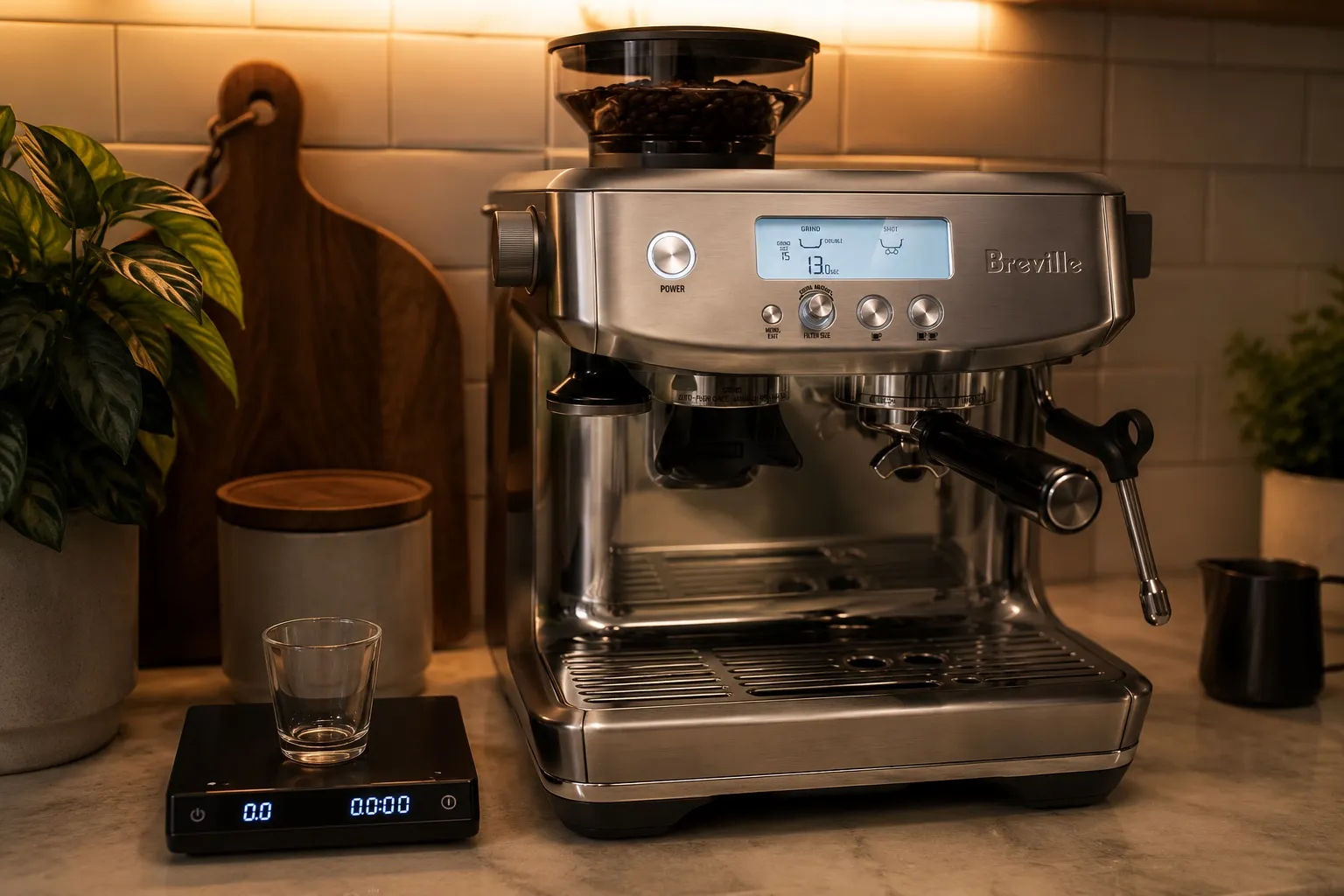
The Barista Pro 878 has been my home machine for a while now, and the thing that took me longest to accept is that “dialing in” isn’t a one-time event. Every new bag shifts things. A bag three days off roast behaves nothing like the same beans two weeks later, because fresh beans are still degassing and the rush of gas changes how the water moves. What you’re after, then, is less a magic setting than a routine you can run in five minutes whenever the coffee changes.
Here’s the routine I land on, and why each step is there.
Does this also work on the Express, Touch, and Impress?
Short answer: yes, almost all of it. The Pro is my machine, but Breville builds most of its Barista line on the same bones. The Barista Express (BES870), the Express Impress (BES876), the Touch (BES880), and the Touch Impress share the parts that actually shape a shot: the 54mm portafilter and the same baskets, plus an integrated conical burr grinder with an outer dial and an adjustable inner burr. Everything that differs between the models sits outside dialing in. The heating system isn’t shared (the Pro’s ThermoJet is ready in seconds, the Express’s thermocoil takes about half a minute), nor is the display (an analog gauge, an LCD, or a touchscreen), the Touch froths milk for you, and the Impress models tamp for you. None of that touches grind, dose, yield, or time, so the routine below runs the same on every one of them.
One difference does matter, and it’s the grind dial. The models don’t count their settings the same way: the Pro has 30 steps, the Express around 18, the Express Impress 25. So the specific numbers I give later are Pro numbers. On another machine, don’t copy the number, copy the move: start a little finer than the dial’s midpoint and let the shot clock guide you from there. If you’re on an Impress, its assisted tamping handles the distribute-and-tamp step at the end, so you can let the machine set the puck and skip that part.
Use the single-wall basket, not the pressurized one
Before any of this works, you have to be brewing on the right basket, and this is where most Barista owners get stuck without realizing it. Every machine in the line ships with two kinds of filter basket, and they behave nothing alike.
- Dual-wall (pressurized) baskets hide a single pinhole under a false floor. That pinhole creates artificial back-pressure, so you get thick crema no matter how coarse or stale the coffee is. They exist to make pre-ground supermarket coffee look good, and they’re forgiving on purpose.
- Single-wall (non-pressurized) baskets have a normal field of holes and no false floor. Now the coffee itself provides all the resistance, which means grind, dose, and tamp suddenly decide the shot.
Here’s the trap: the pressurized basket ignores your grind. You can run the dial from one end to the other and the shot barely moves, because the pinhole, not the puck, is metering the flow. People spend weeks “dialing in” on the dual-wall basket, see nothing change, and decide the machine is broken. It isn’t. The basket is doing exactly its job, which is to mask the variable you’re trying to read.
So step one is to fit the single-wall basket. The shots will look a little worse at first, thinner crema, more truthful, and now every grind change shows up in the cup. The baskets are marked “1 cup” and “2 cup”; for a double you want the larger single-wall one. The Impress models tamp for you, but the basket is still your call, so check which one is seated before you blame the grind.
Dialing in the Breville Barista Pro starts with a scale
The Pro has a built-in grinder with a timed dose. It’s convenient, and it is not accurate enough to dial in espresso, because the amount it spits out for the same time setting drifts as the beans change. So I skip the guesswork and weigh.
You need two numbers: the dose going into the basket, and the yield coming out. A small scale that fits under the portafilter or on the drip tray covers both. This is the single biggest upgrade to consistency, ahead of any accessory.
For the standard double basket, I aim for 18 grams in. The 54mm Breville baskets run a little smaller than the commercial 58mm standard, so if 18g feels packed and the puck screws into the shower screen, drop to 17g. You want a sliver of gap above the puck, not a jammed basket.
Setting the dose: the grind-amount dial and the Razor
The machine grinds straight into the portafilter, and how much it delivers is set by the grind amount dial, which only controls how long the burrs spin. Set it roughly, weigh what lands, and nudge the dial until one grind drops near your target. One quirk to know: the same number of seconds gives a different weight as you change grind size, because finer grounds pack more tightly into the basket, so re-check the dose whenever you move the grind dial much.
Two tools help you finish the puck at the right level:
- The Razor (Express and Pro). Breville includes a dose-trimming tool called the Razor. After you tamp, you seat it on the basket rim and sweep the extra grounds off, which leaves a repeatable gap between the puck and the shower screen. Too little gap and the puck smears into the screen; too much and it floats and channels.
- The Impress system (Impress models). On the Express Impress and Touch Impress, the machine measures the dose, tamps it at a consistent pressure, trims the level, and then tells you to add or drop a little next time. It folds the Razor and the tamp into one motion, which is most of what those models are selling.
Weigh the dry dose anyway. The on-board dosing gets you close; the scale makes it exact, and exact is what lets shot time mean anything.
The target
Everything keys off one baseline:
| In | Out | Time | Ratio |
|---|---|---|---|
| 18 g | ~36 g | 25–30 sec | 1:2 |
Those numbers are a starting frame, not a religion. But they give you a fixed point, so the only real variable left is grind. Hold the dose and the yield steady, and shot time becomes a clean readout of whether your grind is right.
Setting the grind
The Pro has 30 grind settings on the dial. The factory start is around the middle, and the middle is too coarse for most fresh espresso, so I begin finer than feels intuitive:
| Roast | Start around | Why |
|---|---|---|
| Medium, in its window | Setting 6–8 | A sane middle-fine starting point |
| Dark (more soluble, faster) | Setting ~4 | Dark beans gush unless you slow the water down |
These are starting guesses, not destinations. The right dial position depends on the beans, the burr wear, and the humidity, so treat the number as a place to begin and let shot time correct you. And remember these are Pro settings: on an Express, Touch, or Impress the dial counts differently, so read them as “a touch finer than the midpoint,” not as literal numbers.
One note on the inner burr: the Pro lets you adjust the upper burr inside the hopper for extra range if the outer dial bottoms out. I’ve rarely needed it, but if you’re at setting 1 and shots still run fast, that’s the next move.
The loop
Now you run shots and read the clock.
Pull to 36 grams out and watch the timer on the display:
- Under ~24 seconds: water moved too fast. Grind finer, pull again.
- Over ~35 seconds: water moved too slow. Grind coarser.
The flow tells you things too. A good shot starts dripping after about 8 to 12 seconds, then runs in a steady tail, the color of warm honey thinning to pale. Sprays out fast and blond almost immediately? Too coarse. Takes forever to start, then drips dark and stuttering? Too fine.
Change grind in small steps, one or two settings at a time, then taste. The clock is a guide, not the verdict.
Pre-infusion and temperature, the last two levers
Once grind, dose, and yield hold steady, two gentler controls can clean up a stubborn shot.
Pre-infusion is a low-pressure soak at the start, before the pump ramps to full pressure. It wets the puck evenly so water doesn’t drill a hole straight through dry grounds, which means fewer channels and a more even extraction. Every Barista machine runs some pre-infusion on its own. The Pro is the one that lets you program a longer pre-infusion in its settings, and stretching it out often settles a puck that keeps channeling. The Express and Touch use a fixed pre-infusion you can’t lengthen from a menu, though on the Express you can improvise a longer soak by holding the manual button at the start of the shot.
Temperature you can adjust across the whole line, just by different amounts. All of them sit near a 93°C default and let you move a couple of degrees either way, and the Touch offers the widest set of steps. Hotter water extracts faster and builds body, sliding toward bitterness if you push it; cooler leans bright and acidic. Nudge it up to tame a sharp light roast, down to round off a harsh dark one.
Leave both alone until the grind is doing its job. They’re finishing touches, not starting points, and you still move one thing at a time.
Let taste have the final word
Time gets you close. Your mouth closes the gap. If a dialed-in shot still tastes sour and sharp, it’s under-extracted even when the clock looked fine, so go a little finer. Bitter and drying means over-extracted, so go a little coarser. The clock and the cup usually agree; when they don’t, trust the cup.
Two small things that matter more on this machine than you’d expect:
- Distribute and tamp evenly. The Pro is forgiving, but an uneven puck channels in a way no grind setting can fix, and it reads as a sour-and-harsh shot that sends you chasing settings in circles. Give the grounds a quick distribution with a finger or a tool, then tamp level.
- Purge before you lock in. If the machine has been sitting, run a little water through the group head first so you’re brewing at temperature.
When the beans, not the dial, are the problem
Sometimes the grind is right and the shot still misbehaves, and the beans are the reason.
- Too fresh. Coffee in its first days off roast is full of carbon dioxide. That gas erupts under pressure, swells the puck, and forces water into channels, so very fresh beans gush, spit, and taste hollow wherever you set the dial. Give a new bag five to ten days to settle before you judge it. This is the degassing the intro mentioned, and under espresso pressure it shows up far louder than on filter.
- Too old. Past a month or so, beans go flat and the shot turns thin and papery, and no grind setting brings back what’s gone. Buy in amounts you’ll finish inside three or four weeks.
- Stuck in the grinder. Breville’s grinder holds a couple of grams of old grounds in the chute between sessions. When you switch beans, or after the machine has sat for days, run a short throwaway grind to clear the stale stuff before you dose, so a great new bag doesn’t taste like the last one for the first shot or two.
If the beans are fresh, rested, and ground clean and a shot still runs sour or bitter, then it’s back to the grind dial, not the pantry.
Quick troubleshooting: symptom, cause, fix
When a shot goes wrong, the symptom usually names the cure. Keep this within reach for the first few weeks:
| Symptom | Likely cause | First move |
|---|---|---|
| Sprays fast, blond, watery, under 20 sec | Grind too coarse, or pressurized basket | Grind finer; confirm the single-wall basket |
| Barely drips, dark, stuttering, over 40 sec | Grind too fine, or dose too high | Grind coarser; recheck the gap with the Razor |
| Right time, still sour and sharp | Under-extracted | Grind a touch finer, or raise temperature |
| Right time, still bitter and drying | Over-extracted | Grind a touch coarser, or lower temperature |
| Shots swing with nothing changed | Channeling from an uneven puck | Distribute and tamp level; work in WDT |
| No crema, thin, on fresh beans | Wrong basket, or stale retention | Switch to single-wall; purge the grinder |
| Gushing and spitting on a days-old bag | Beans too fresh, too much CO2 | Rest the beans a few more days |
Don’t memorize it. After a couple of weeks the symptom and the fix fold into a single motion, and you’ll be reaching for the dial before you’ve finished the sip.
Write it down
When a bag is dialed, I jot the grind setting and the beans on a sticky note. Not because I’ll remember, but because I won’t. Next bag of the same coffee, I start from that note instead of from scratch, and I’m drinking a good shot in two pulls instead of ten.
That’s it, end to end. Weigh in, weigh out, fix the time with grind, let taste have the last word, keep notes. It reads fussy on the page. In practice it’s a few minutes per bag and then weeks of shots that just work, which is a trade I’ll take every time.
There’s a deeper “why” behind the sour-versus-bitter calls, worth reading slowly when you have a minute.