Coffee Brewing Methods Compared: Which One Suits You
A plain guide to the main coffee brewing methods, from espresso to cold brew: how each one works, its pros and cons, and why the cup tastes the way it does.
This post may contain affiliate links — see the full disclosure.
Walk into a well-stocked kitchen shop and the wall of coffee gear can look like a dozen unrelated inventions, when nearly every one of the common coffee brewing methods is a variation on just three ways of getting water and ground coffee to meet: you can steep the grounds in water, you can run water through them, or you can force water through them under pressure. Once you can see which family a brewer belongs to, its cup makes sense before you’ve tasted it.
This is a tour of the main methods, what each one does well, where it falls down, and why the same beans can taste so different depending on how you brew them.
The three families, and why they taste different
Every method here is an immersion brewer, a percolation (drip) brewer, or a pressure brewer. The differences between those three families explain most of what ends up in your cup.
Immersion means the grounds sit fully submerged in the water for the whole brew, like tea. French press, AeroPress, and cold brew all work this way. Because the coffee steeps in water that’s slowly getting more saturated as it extracts, immersion tends to be even, forgiving, and full-bodied. The flip side is a little less of the bright, sharp clarity you get from the other family.
Percolation, or drip, means fresh water passes through a bed of grounds and drains away, never pooling. Pour-over and automatic drip machines live here. Each drop of water that touches the coffee is relatively fresh, so it extracts more aggressively and pulls out more of the delicate, aromatic, higher notes. That’s why a good pour-over reads clean and bright, with individual flavors you can pick apart. James Hoffmann and coffee scientists make the same point: percolation with clean water tends to produce more clarity and defined acidity, immersion more body and roundness.
Pressure is its own thing. Espresso forces hot water through a tightly packed puck at around 9 bars, roughly nine times atmospheric pressure. That does something the other two families can’t: it emulsifies the coffee’s oils and dissolves solubles fast into a small, intense, syrupy shot with a layer of crema on top.
There’s a second lever riding on top of all this: the filter. A paper filter traps the coffee’s natural oils (the diterpenes) and the microscopic fines left over from grinding, so the cup comes out clean and light-bodied. A metal mesh filter, or no filter at all, lets those oils and fines through for a heavier, rounder, more textured cup. This is most of the difference between a paper pour-over and a French press.
The main coffee brewing methods, side by side
Here’s the shape of each method at a glance. Grind and ratio are starting points, not gospel, and the numbers below are the commonly cited ranges rather than fixed rules.
| Method | Family | Grind | Ratio | Time | Body & clarity |
|---|---|---|---|---|---|
| Espresso | Pressure (~9 bar) | Very fine | ~1:2 | 25-30 sec | Intense, syrupy, crema |
| Pour-over | Percolation | Medium | ~1:16-17 | 2.5-4 min | Light, clean, bright |
| French press | Immersion (metal) | Coarse | ~1:15-17 | ~4 min | Full, heavy, some sediment |
| AeroPress | Immersion + light press | Medium-fine | ~1:15 | 1-2 min | Clean, smooth, flexible |
| Cold brew | Immersion (cold) | Coarse | ~1:8 concentrate | 12-24 hr | Smooth, mellow, low-bitter |
| Moka pot | Percolation (~1-1.5 bar) | Fine-medium | pot decides | 4-5 min | Bold, concentrated |
| Automatic drip | Percolation | Medium | ~1:16-17 | 4-6 min | Clean, familiar, hands-off |
Water temperature is broadly the same across the hot methods: the SCA target range is about 195 to 205°F (90 to 96°C), and cold brew is the obvious exception, using cold or room-temperature water the whole way. If you want the reasoning behind that range, the water for coffee piece digs into it.
Espresso
Espresso is the pressure family on its own. A pump drives water through a fine, compacted puck in under half a minute, producing a concentrated shot topped with crema. Everything about it is intense and fast, which is exactly why it’s the base for milk drinks and the hardest method to get consistently right.
- Pros: Intense flavor, the foundation of lattes and cappuccinos, fast once dialed in.
- Cons: Expensive gear, steep learning curve, unforgiving of grind and dose errors, needs a good grinder more than any other method.
With no milk or dilution to soften things, espresso rewards precise grinding and shows extraction faults immediately. A shot that’s sour or bitter is telling you something specific about your grind and timing.
Pour-over
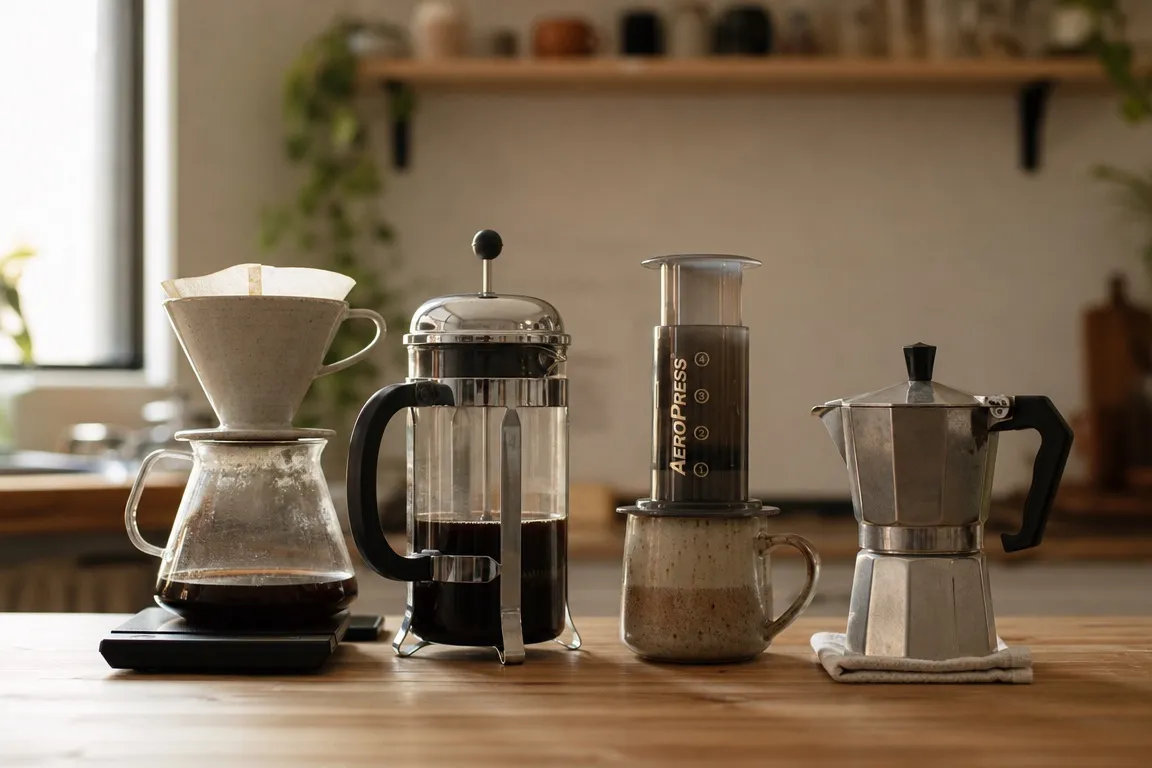
Pour-over is the clarity champion. You pour hot water over a bed of medium grounds in a paper filter, and gravity does the rest. The clean, bright, aromatic cup it produces is why specialty cafes reach for it to show off a light-roast single origin. The tradeoff is that it’s hands-on: your pour speed and technique change the cup, so it takes practice to get repeatable.
- Pros: Clean, bright, expressive cup, cheap to start, great for tasting a bean’s character.
- Cons: Requires attention and a steady pour, one cup at a time, a gooseneck kettle and a scale help a lot.
If you want to get good at this one, the complete pour-over guide walks through drippers, ratios, and a repeatable recipe.
French press
The French press is full immersion behind a metal mesh. Grounds steep in the water for about four minutes, then you press the plunger to separate them. Because metal lets the oils and fines through, the cup is heavy, rich, and textured, with a little sediment at the bottom that comes with the territory. It’s one of the most forgiving methods, since you’re steeping by the clock rather than managing a pour.
- Pros: Full-bodied and rich, dead simple, no paper to buy, brews several cups at once.
- Cons: Sediment in the cup, oils pass through (relevant if you watch cholesterol), can turn bitter if you leave the grounds sitting in it.
AeroPress
The AeroPress is an immersion brewer with a gentle push at the end: you steep the coffee, then press it through a paper filter with light hand pressure. That combination gives you immersion’s evenness and paper’s clean finish in one quick, nearly foolproof cup. It’s also cheap, near-indestructible, and the natural choice for travel.
- Pros: Forgiving, fast, clean cup, cheap and portable, easy cleanup.
- Cons: Makes one small cup at a time, not true espresso despite the marketing, plastic won’t appeal to everyone.
Cold brew
Cold brew steeps coarse grounds in cold or room-temperature water for 12 to 24 hours. No heat at any point. The long, cold extraction pulls plenty of sugar, body, and caffeine while leaving behind much of the harsher, bitter side, so the result is famously smooth and mellow. It also makes a big batch you can keep in the fridge for days.
- Pros: Very smooth and low-bitterness, make-ahead in big batches, no kettle needed.
- Cons: Slow (plan a day ahead), uses a lot of coffee for the yield, ties up fridge space.
A quick word on the “cold brew is less acidic” claim, because it’s more nuanced than the marketing suggests. The often-cited 2018 Scientific Reports study by Rao and Fuller found that hot and cold brews landed at comparable pH (around 4.85 to 5.13), and the hot brews carried slightly more titratable acid. So the measured acidity gap is smaller than you’d think. What’s reliable is the taste: cold brew is genuinely perceived as smoother and less sour and bitter, which a separate sensory study backed up. Treat the smoothness as real and the exact “60% less acidic” figures as shaky. Cold brew is also a different animal from flash brew, which brews hot straight onto ice to keep a bean’s bright, aromatic side intact.
Moka pot and automatic drip
Two worth mentioning quickly. The moka pot is a stovetop percolator that uses steam pressure, around 1 to 1.5 bar, to push water up through the grounds. People call it “stovetop espresso,” but at a fraction of espresso’s 9 bars it makes something bolder and more concentrated than drip, not a true shot. Automatic drip is percolation on autopilot: the machine heats and pours the water for you, which is why it’s the unglamorous workhorse of most kitchens. It trades some control for real convenience, and a good one brews a clean, reliable pot without any technique at all.
What about caffeine?
This trips up a lot of people, so it’s worth being careful. A single espresso has less total caffeine than a full mug of drip coffee, even though it’s far more concentrated per ounce. Cold brew concentrate can be very high in caffeine simply because it’s brewed strong. The honest answer is that caffeine depends far more on how much coffee you use and how you dilute it than on the method’s name, so per-serving comparisons between methods are mostly misleading. If you care about the numbers, weighing your dose tells you more than the brewer does.
So which method should you pick?
There’s no best method, only the one that fits the cup you want and the effort you’ll really put in.
- You want a clean, bright cup and enjoy the ritual: pour-over.
- You want rich and full-bodied with almost no fuss: French press.
- You want one good cup fast, or something for travel: AeroPress.
- You want milk drinks and don’t mind the investment: espresso.
- You want smooth iced coffee waiting in the fridge: cold brew.
- You want to press a button and get on with your morning: automatic drip.
Most people who fall for coffee end up owning two or three of these, because they were never really competitors, just different tools for different mornings. The same bag of beans will taste bright and floral through a paper pour-over and deep and heavy through a press, and neither cup is wrong. Pick the one that matches how you actually drink, get to know it, and let the beans do the rest.
Sources: Rao & Fuller, Scientific Reports (2018), acidity of cold brew; Sensory analysis of cold vs hot immersion coffee (PMC, 2022); Coffee ad Astra, why percolation and immersion taste different; Moustache Coffee Club, how brewing method affects flavor.